Pistol
WA/PPC 1500, NPA Police Pistol, Service Pistol, ISSF, Action Match and Bullseye are all in there already, with the real times, the real pauses, and the warnings where the rules put them. There is nothing to program before your first string.
A stage, start to finish
Seven seconds to get ready, then five series of three, five seconds facing away between each. The targets are gone before you've thought about it.
It signals every one of those changes. You just shoot them.
Your discipline is in there
You shouldn't have to program a timer before you can use it. Every one of these is built in with the correct times — and if your club shoots something of its own, you can build it and save it.
On the line
Once a string is running there's a target in front of you and a sight picture to hold. Nobody reads a countdown at that point — so the timer has to tell you where you are without being watched.
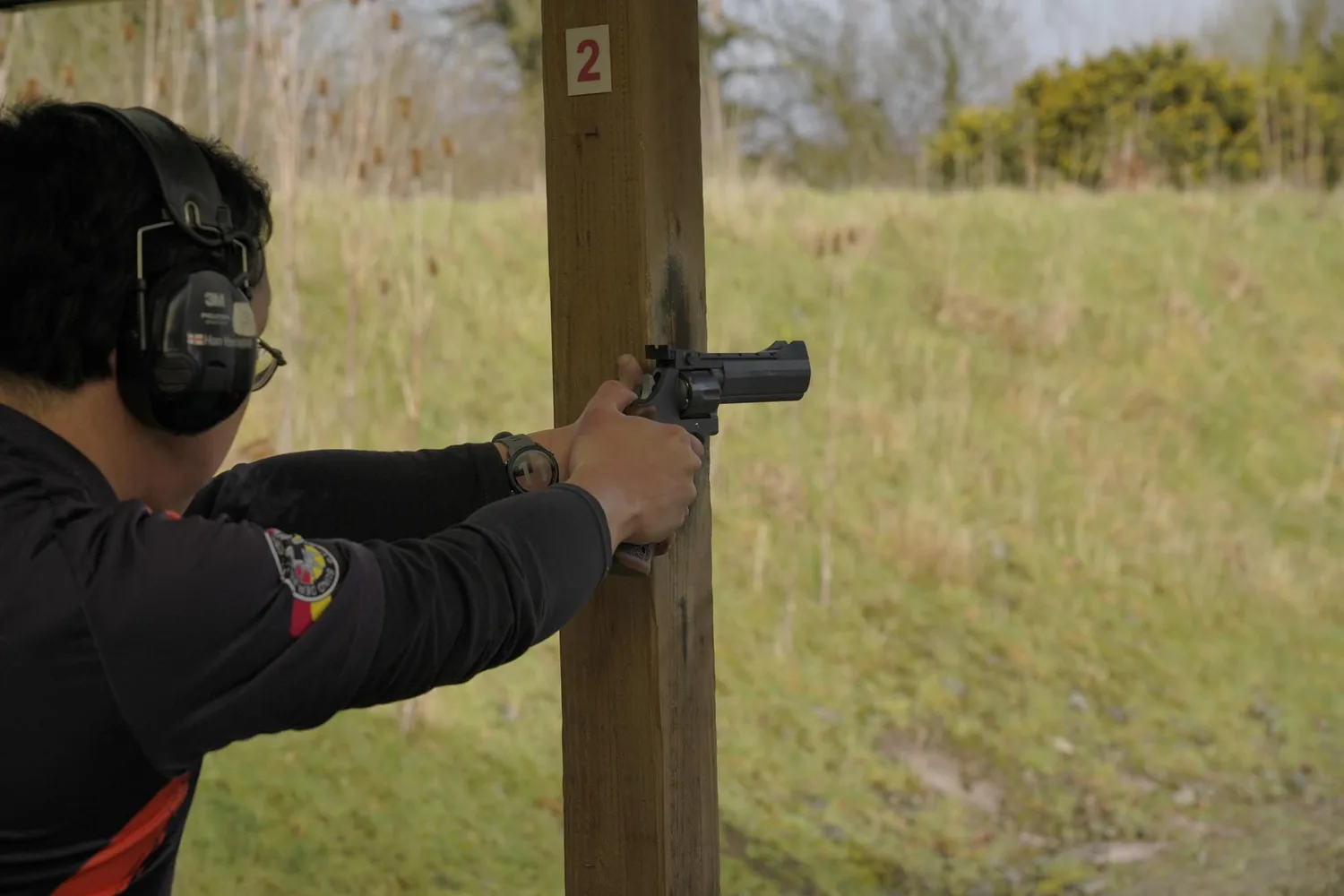
Almost every pistol shooter turns the watch to the inside of the wrist, so the face is there with the gun out in front. Nothing minds — the display and the gesture both work out which way up they are for themselves.
This is the part that matters. Set the warnings to the points your discipline actually calls, and you can shoot the whole string on feel without a glance.
Sound off entirely, vibration only. Several disciplines don't permit an audible signal at the firing point, so this isn't a compromise — it's how plenty of people run it all the time.
Pistol questions
No. It's a PAR timer: it runs the stage — the load, the firing time, the turn-aways, the pauses and the warnings — exactly as your match calls them. It doesn't listen for gunshots and it doesn't measure your split times. If splits are what you're after, this isn't the tool.
Yes. Subscribed, your iPhone or Android is a complete timer in its own right, no watch involved. Free, the phone app is a companion to a watch you already have — which is where most people build their sequences and DOPE cards anyway.
Build it yourself — your own load time, firing times and pauses, named however you like. You can keep up to ten of your own stages saved.
Yes — sound off entirely, vibration only. Several disciplines prohibit an audible signal at the firing point, so silent running isn't an afterthought; it's how a lot of people use it. You still feel every change on your wrist.
Either way, whichever your discipline calls it. Set it once and it remembers.
No. Touch Guard locks the screen while a stage is running, so a cuff or a jacket can't kill your string.
Pick a match below, or write your own stage and watch it run.
Plus Mode is the run-up before a stage — usually set to however long the targets stay turned away, so you can start the timer before match firing commences and the stage comes in exactly as they turn. It's a setting on the watch rather than part of the sequence: 1–15 seconds, set to 7 here so you can see it work. A sequence beginning with # ignores it.
A stage is a list of phases separated by :. Inside a phase, the first number is the time in seconds and anything after a . is a warning, given as seconds remaining.
20.10.3 — 20 seconds, warnings at 10 and 3 left3:-5:3 — 3 seconds, 5 seconds facing away, 3 seconds#90.60.30.10.5 — a 90-second PRS par with four warningsPrefixes — # starts immediately, ignoring your Plus Mode lead-in. ^ forces the count upward for that stage.
A minus sign means you are not shooting during that phase — a load period or a turn-away. The watch shows those in blue, and Time Slice sits them out entirely.
A zero on any phase after the first is a pause: the timer stops and waits for you to press start again.
The rules below are the app's own. If the watch would reject what you type, so will this.
 by Dugong Technology