Precision rifle · PRS
Par times, warnings you can feel, and your DOPE on the same wrist. Built for shooters who are prone behind a rifle when the clock starts — not standing next to it.
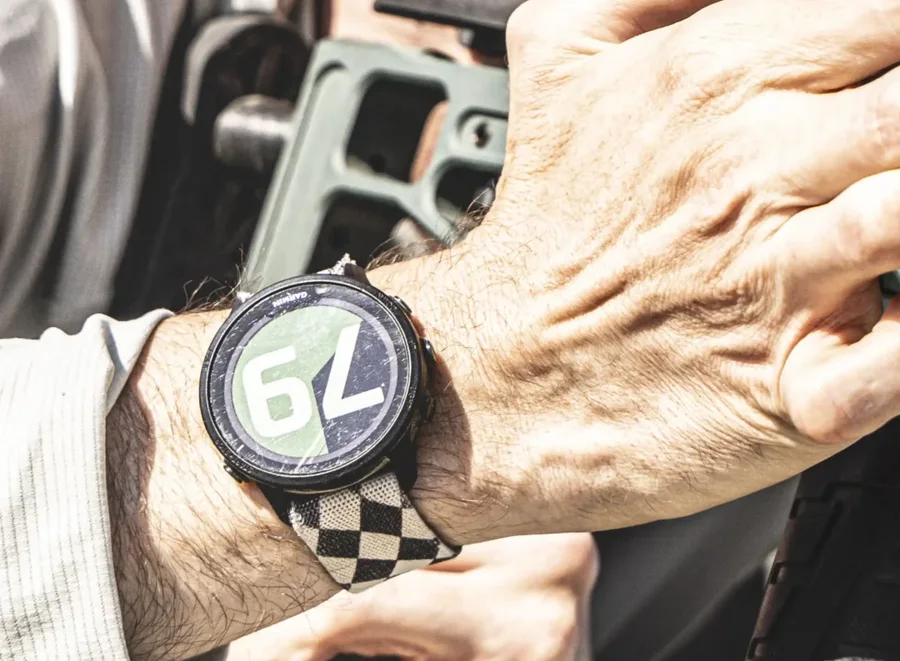
A 90-second stage
Warnings you feel rather than watch, so you always know how much stage is left without breaking your cheek weld. Put them wherever you want them — every shooter has their own idea of when they need telling, and this one's yours to set.
Par times to start from:
45s · 60s · 90s · 100s · 120s · 180s · 300s — then change the time, change the warnings, or build the stage from scratch.
What matters behind a rifle
Precision rifle asks something a pistol timer never has to: work perfectly for someone who cannot reach it, cannot look at it, and cannot afford to move.
Gesture start is there if you want it — a movement of the arm the watch is already on, so your other hand can stay where it is and you needn't look down to find a button.
Come-ups and windage for every distance, right where you can see them. No card gone soft in the rain, no scrolling a phone with wet hands.
The face fills with colour as the stage runs — green, then blue, then yellow, then red. You don't read it, you catch it in the corner of your eye: red on your wrist means you're nearly out of time. Some shooters live by it, plenty never switch it on.
Put them where your stage needs them, and each one is a pulse on the wrist. You track the stage by feel, without a sound being made and without looking down. An Apple Watch taps too — Garmin plays the full pattern.
The wind call that worked. The prop that cost you two impacts. Written down before you've walked back to the truck and forgotten it.
The Garmin app runs entirely on the watch. Matches are usually a long way from a tower, and it doesn't care.
Plenty of shooters turn the watch so the face reads with their arms out on the gun. Nothing minds — the display and the gesture both work out where they are for themselves.
Match day
Pistol disciplines have their times written in a rulebook. Precision rifle doesn't — every match director builds their own stages, and you often don't see the detail until you're standing at the brief. New distances, new par times, a stage that wants a different warning than the last one.
So the setup can't be something you did at home on Thursday. It has to be something you can change in the truck at seven in the morning, on a property with one bar of signal and no data.
The companion app talks to your watch directly over Bluetooth — there's no website in the middle and no server to reach. Sit in the truck with no reception at all and you can still:
Typing all that on a watch would be miserable. Typing it on your phone takes a minute, and it's on your wrist before you've got your kit out of the back.
Why it works with no signal
Your phone and your watch are already paired to each other over Bluetooth. Shot Clock uses that link directly, so your stages and cards never go near the internet. If you want to build things at home on a big screen the web portal is there too — but you never need it, and you certainly don't need it at a match.
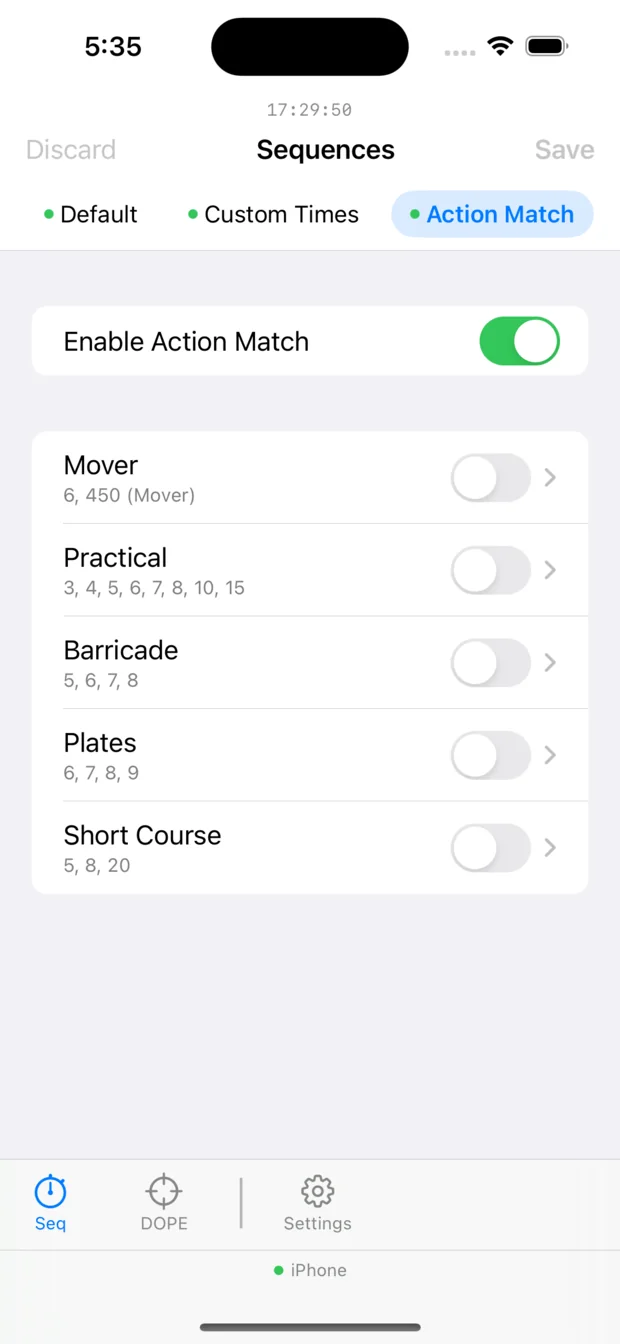
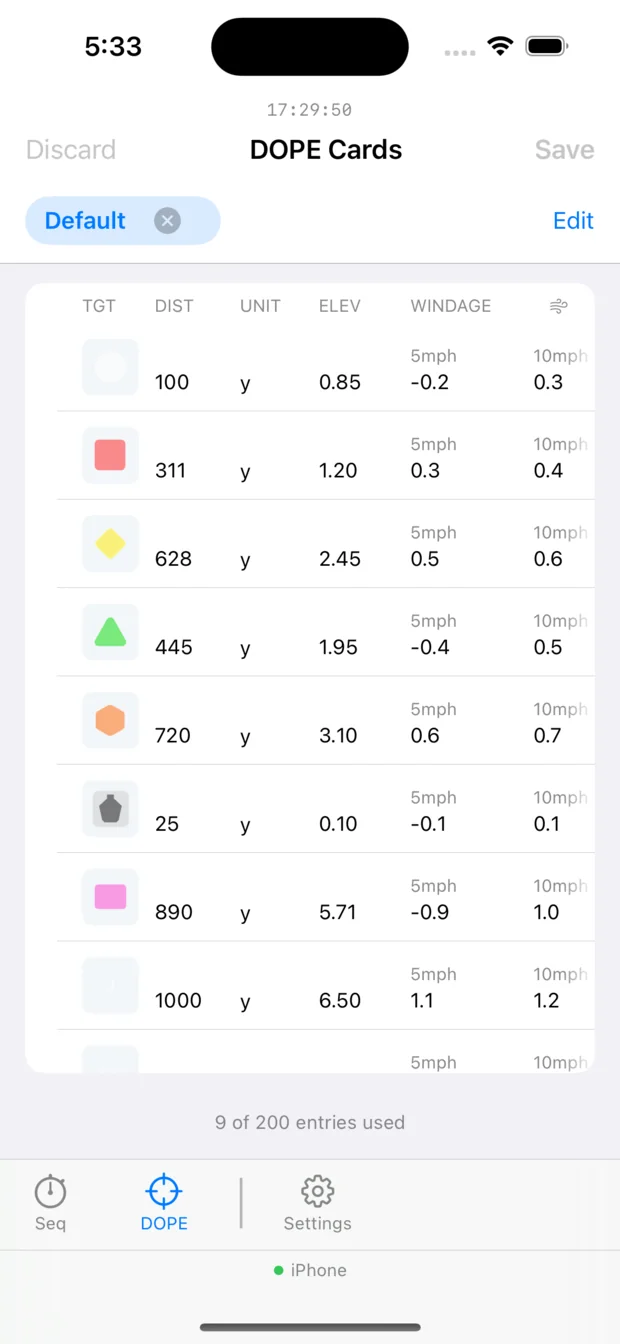
Every match ready to switch on, and your DOPE edited on a screen you can actually see.
Built on what shooters tell us
This isn't a big company with a roadmap committee. When a shooter says something doesn't work the way it should on the clock, it usually gets fixed in the next version — and quite often that's weeks, not years.
The clearest example is the one you'll use most. Alerts at the transitions a stage actually has are what let a shooter stop looking at the clock at all — and being able to move them yourself, so they fall where your stage needs them, came straight from a customer.
Recent examples, all of them somebody's feedback first:
Tell us what you needDOPE cards are on the watch because customers asked for them. The feature exists because of shooters — and it's still being sharpened by them, which is why the elevation column is now bold and 25% larger than the rest of the row.
The start alert was landing a fraction late, and by a different amount each time. It now fires on the press itself, so the signal is the instant you gave it.
Sequence sync used to be limited to newer watches. It now reaches every supported device — sixteen more models, including some quite old ones.
Between matches
Set a 90-second par, build your position, and run the stage in the garage. The pressure of the clock is most of what makes a match hard — and it's the part most people never practise.
Add Shot Clock Diary — a separate app — and every one of those sessions becomes a record: what you ran, how it went, what you'd change. Come back in three months and you can see whether the change worked.
See Shot Clock DiaryYour come-ups and windage at the distances you actually shoot — on the watch as well as the phone.
Precision rifle questions
The button still works, and most people use it. But turn gesture start on and you can begin a stage with a movement of the arm the watch is already on — no second hand reaching across, and no looking down to find a button. Plenty of rifle shooters leave it on for exactly that.
Worth knowing before you rely on it: it can start when you didn't mean it to. Not because it's unreliable — it reads the movement perfectly well — but because it's a movement people sometimes make without thinking. Scratching your head is the classic one. Three sensitivity settings help, and it's a switch you can turn off between stages. Whether that trade is worth it depends on you.
45, 60, 90, 100, 120, 180 and 300 seconds are there to start from, but none of it is fixed. Change the par, change where the warnings fall, or build a stage from scratch and save it under your own name.
Yes, and most people do. The defaults sit at 60, 30, 10 and 5 seconds remaining on a 90-second stage, but every shooter has their own idea of when they want telling. Put them where they're useful to you.
That's rather the point — see setting up at the match above. Edit it on your phone in the truck and push it to the watch over Bluetooth. No signal needed.
Yes. On Garmin the whole thing runs on the watch. Leave the phone in the truck.
On Garmin it can, so your stages show up alongside everything else in Connect.
Pick a match below, or write your own stage and watch it run.
Plus Mode is the run-up before a stage — usually set to however long the targets stay turned away, so you can start the timer before match firing commences and the stage comes in exactly as they turn. It's a setting on the watch rather than part of the sequence: 1–15 seconds, set to 7 here so you can see it work. A sequence beginning with # ignores it.
A stage is a list of phases separated by :. Inside a phase, the first number is the time in seconds and anything after a . is a warning, given as seconds remaining.
20.10.3 — 20 seconds, warnings at 10 and 3 left3:-5:3 — 3 seconds, 5 seconds facing away, 3 seconds#90.60.30.10.5 — a 90-second PRS par with four warningsPrefixes — # starts immediately, ignoring your Plus Mode lead-in. ^ forces the count upward for that stage.
A minus sign means you are not shooting during that phase — a load period or a turn-away. The watch shows those in blue, and Time Slice sits them out entirely.
A zero on any phase after the first is a pause: the timer stops and waits for you to press start again.
The rules below are the app's own. If the watch would reject what you type, so will this.
 by Dugong Technology